Acid
They typically taste sour and turn blue litmus paper red. It releases protons, or H+ ions. The hydronium ions (H3O+) that are formed in solution are the result of this donation of protons.

Examples:
- Hydrochloric acid (HCl): Found in the stomach and aids in digestion. It’s also used in industrial processes, such as cleaning and pickling.
- Sulfuric acid (H₂SO₄): Widely used in car batteries, as well as in the production of fertilizers, detergents, and explosives.
- Citric acid: Naturally found in citrus fruits like lemons and oranges. It’s used as a flavoring agent in food and beverages and as a preservative.

Properties:
- React with metals to produce hydrogen gas.
- React with bases to form water and a salt in a neutralization reaction.
- Conduct electricity when dissolved in water (electrolytes).
- Have a pH less than 7.
Base
They typically taste bitter and feel slippery. When dissolved in water, bases are substances that release hydroxide ions (OH⁻) when dissolved in water. or absorb protons (H⁺ ions).

Examples:
- Sodium hydroxide (NaOH): Also known as caustic soda, it’s used in the production of soap, paper, and various household cleaning agents.
- Ammonia (NH₃): Used in household cleaning products, fertilizers, and as a refrigerant. Ammonia is also produced naturally in the decomposition of organic matter.
- Magnesium hydroxide (Mg(OH)₂): Commonly known as milk of magnesia, it’s used as an antacid to neutralize stomach acid and relieve indigestion.
Properties:
- React with acids to form water and a salt in a neutralization reaction.
- Turn red litmus paper blue.
- Conduct electricity when dissolved in water (electrolytes).
- Have a pH greater than 7.
Salt
Salts are compounds formed by the neutralization reaction between an acid and a base. They are composed of positive ions (from the base) and negative ions (from the acid).
Examples:
- Sodium chloride (NaCl): Common table salt, formed by the reaction between hydrochloric acid (HCl) and sodium hydroxide (NaOH).
- Calcium carbonate (CaCO₃): Found in limestone, marble, and eggshells. It’s also used as a dietary supplement and antacid.
- Potassium nitrate (KNO₃): Used in fertilizers, fireworks, and as a food preservative (E252).
Properties:
- Generally, exist as crystalline solids at room temperature.
- Many salts are soluble in water, but some are insoluble.
- Salts do not affect litmus paper because they are neutral.
- Salts can conduct electricity when dissolved in water (electrolytes), depending on their solubility.

Neutralization
Neutralization is a chemical reaction between an acid and a base to form water and a salt. It’s called neutralization because the acidic and basic properties of the reactants are neutralized, resulting in a neutral pH solution.
Acid + Base → Salt + Water
In a neutralization reaction, the hydrogen ions (H⁺) from the acid combine with the hydroxide ions (OH⁻) from the base to form water (H₂O). The remaining ions from the acid and base combine to form a salt.
Example:
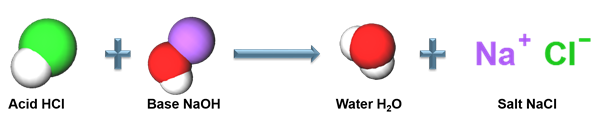
Let’s consider the neutralization of hydrochloric acid (HCl) with sodium hydroxide (NaOH):
HCl (aq) + NaOH (aq) → NaCl (aq) + H₂O (l)
In this reaction, the hydrogen ion from hydrochloric acid (HCl) combines with the hydroxide ion from sodium hydroxide (NaOH) to form water (H₂O). The remaining ions, sodium (Na⁺) from the base and chloride (Cl⁻) from the acid, combine to form sodium chloride (NaCl), which is common table salt.
Properties:
-
- Formation of Water: Water is always produced as a product of neutralization.
- Formation of Salt: A salt is formed as a product of neutralization, composed of the cation from the base and the anion from the acid.
- Change in pH: The pH of the solution changes from acidic or basic to neutral (pH 7) after the reaction.
- Heat Release: Neutralization reactions often release heat, making them exothermic.