
pH Scale
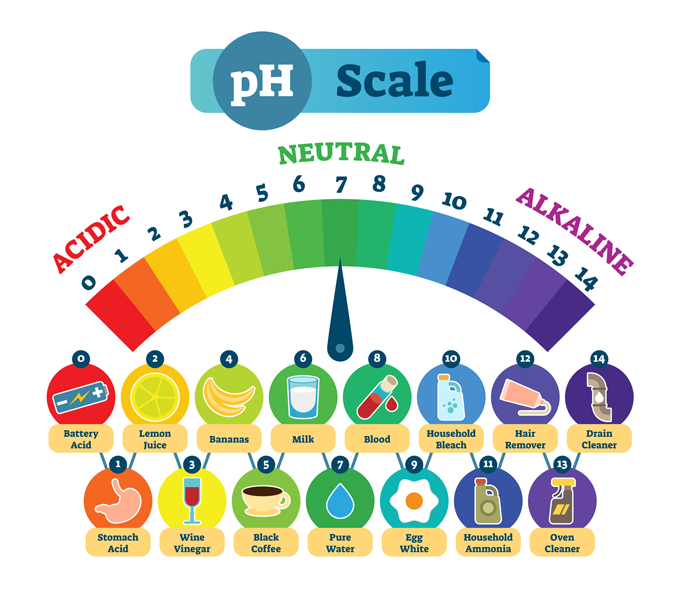
The pH scale is a way of measuring how acidic or basic a substance is. It ranges from 0 to 14, with 7 being neutral.
- Acidity is indicated by a pH of 0 to 6.9. The substance is more acidic when the number is lower. Lemon juice, for instance, is highly acidic with a pH of about 2.
- A substance is neutral at pH 7. Since pure water has a pH of 7, it is neither basic nor acidic.
- Alkalinity (basicity) is measured by a pH range of 7.1 to 14. The more fundamental the substance, the higher the number. Baking soda, for instance, is basic because of its pH of about 9.
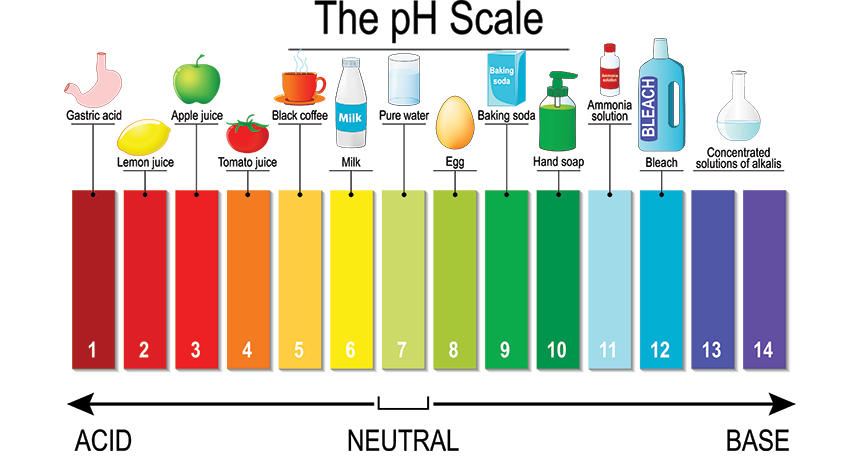
Any substance that has a pH lower than 7 is considered acidic because it contains more hydrogen ions (H+) than hydroxide ions (OH-). If the pH is more than 7, the substance is basic because it contains more hydroxide ions than hydrogen ions.
Understanding the pH scale is important because it helps scientists and chemists determine how acidic or basic a substance is, which can have implications for various processes, from cooking to environmental science.
Acid Base Indicators Examples
Many types of indicators work throughout the pH scale. It is important to choose one that falls within the pH range under consideration. Several common acid-base indicators examples are given below:
Litmus Paper: One common acid and base indicator is litmus paper created by treating filter paper with a dye obtained from lichens. A solution applied to litmus paper will either keep the litmus the same color or change it.
Phenolphthalein Indicator: The phenolphthalein indicator is a weak acid that has two different structures based on whether it is in an alkali (pink) or acid (colorless) solution
Bromothymol Blue Indicator: Bromothymol blue, a weak acid, is most commonly used as an indicator for solutions that are relatively neutral-weak acids and bases. Its pH range is between 6 and 7.6.
Methyl Red Indicator: As an acid and base indicator, methyl red turns red in acidic solutions at pH 4.4 and below, and turns yellow when pH 6.2 is reached. In between these color endpoints, in the pH range 4.4 to 6.2, the color is orange.
Universal Indicator: A universal indicator is a solution that contains a mixture of indicators, often phenolphthalein, methyl red, and bromothymol blue. Identification of an approximate pH is obtained by adding several drops of a universal indicator to a solution.

