Force
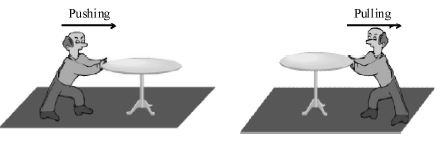
A table can be moved from one place to another by either pushing it or pulling it
 Have you wondered how the shape of a bottle changes when squeezed? Or how can the direction of a moving ball change by kicking it in different ways?
All the above activities can be associated with pushing or pulling.
Therefore, whenever an object is moved, we can say that it has either been pushed or pulled. This push or pull is known as force. In other words, a body moves whenever a force is applied to it. Therefore, a body cannot move unless a force is applied. Apart from push or pull, force is any action that has the tendency to change the position,
shape, or size of an object. Everyday actions such as pushing, pulling, stretching, lifting, squeezing, and twisting are also examples of force. Let us try to list some examples of everyday force and see if we can classify them as push or pull.
Examples
1. Hitting a cricket ball with a bat
2. Opening a door
3. Plucking a flower
4. Flying a kite
5. Moving a wheel barrow
6. Hitting a tennis ball with a racquet
7. Taking a carrot out of the ground
8. Playing on a swing
9. Picking up a shopping bag
10. Squeezing a toothpaste tube
INTERACTION BETWEEN FORCES
Have you ever seen an arm wrestling match?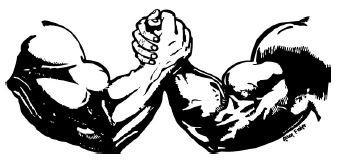
In an arm wrestling match, both the players try to push each other’s hand towards the table. Hands move along the direction of the player who applies a greater force. The player who is able to apply more force wins the match.
A table in your room or a vehicle parked outside your house cannot move unless it is either pushed or pulled. To move a table, you have to either push or pull it.
In cricket, a bat exerts force on the ball. Thus, the ball is able to gain speed and can reach the boundary line. Thus, we can observe that force comes into play when at least two bodies interact with each other. Can you list the two interacting bodies in the cases that we have discussed?
|
Scenario |
Interacting bodies |
|
Arm wrestling Arms of the players Pushing or pulling a table A moving vehicle Bat hitting a ball |
Arms of the players You and the table Vehicle and the road (or the ground) Bat and ball |
EFFECTS OF FORCE
Force cannot be seen, heard, or tasted. Only its effects can be felt or seen. The various effects of force are:
1. It can move a body initially at rest.
2. It can bring a moving body to rest.
3. It can change the direction of a moving body.
4. It can change the speed of a moving body.
5. It can change the shape of a body.
6. It can change the size of a body.
Let us take an example of a football lying in a field (fig – A). When a player hits the ball, it starts moving, i.e., it starts moving only when we apply force. Thus, force can move a body initially at rest.
Now, if the goalkeeper catches the moving ball (fig – B), then it comes to rest. The goalkeeper applies a force to stop the moving ball. Hence, we can say that force can bring a moving body to rest.
If another player kicks the moving ball in the opposite direction (fig – C), then it starts moving in the direction
towards which it is kicked i.e. the direction of the football changes. The player applies force on the football to change its direction. Hence, force can change the direction of a moving body. Also, if the player hits the ball hard, then the net speed of the ball will also change. Hence, the speed of a moving body can be changed by applying force.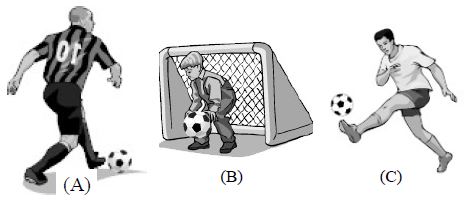
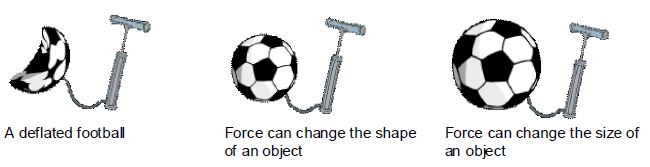
The shape of a deflated football can be changed by inflating it. When you inflate a football, you apply force on the pump. Hence, force can change the shape of an object. Also, if you keep inflating the football, then its size will keep on increasing. Hence, force can change the size of an object.