
Dialysis
- Dialysis is a treatment for people whose kidneys are failing.
- It is a medical procedure used to artificially perform the kidney’s filtration and waste removal functions when the kidneys are no longer able to do so adequately.
- When you have kidney failure, your kidneys don’t filter blood the way they should. As a result, wastes and toxins build up in your bloodstream.
- Dialysis does the work of your kidneys, removing waste products and excess fluid from the blood.
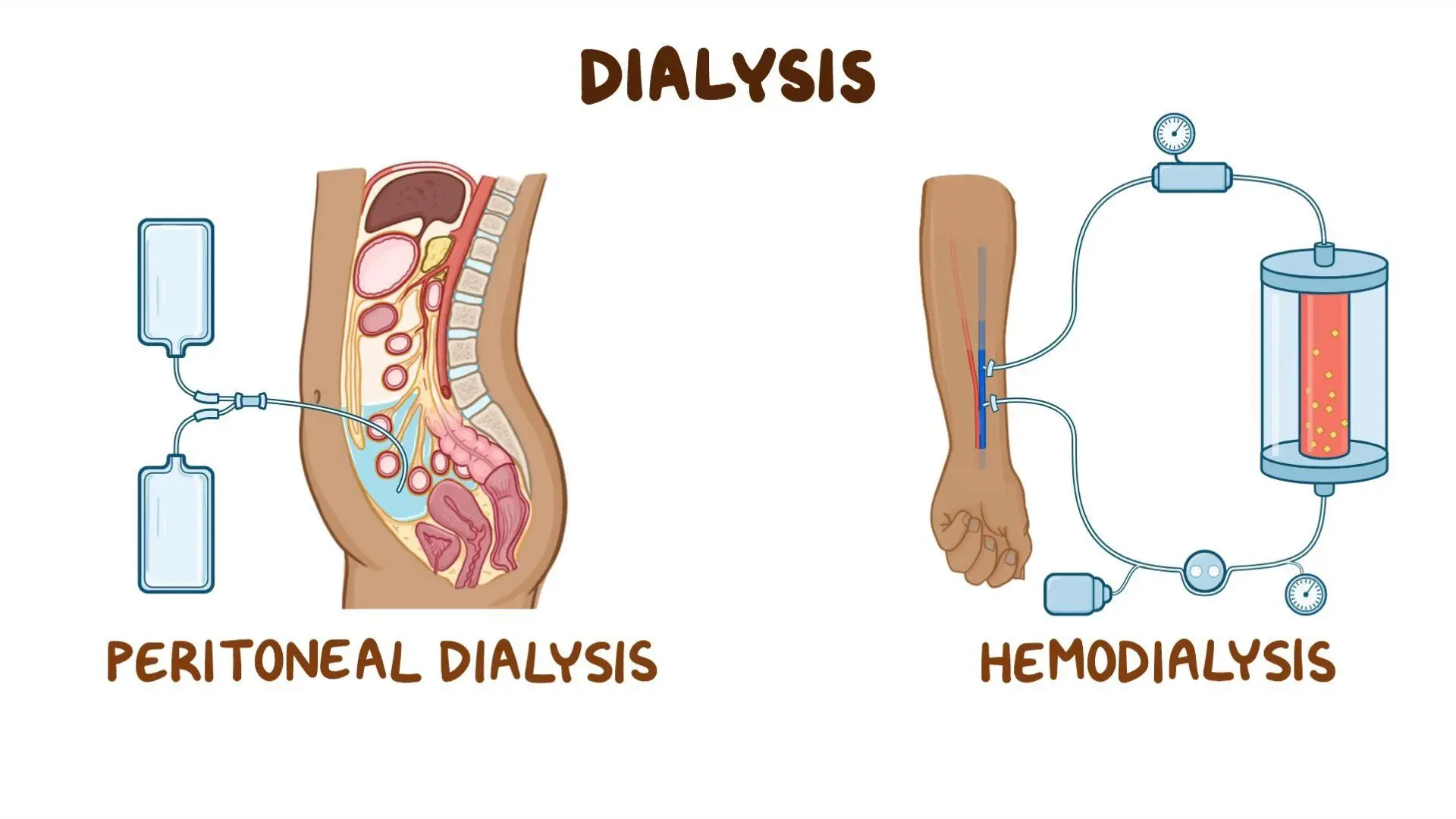
There are two main types of dialysis 1-Hemodialysis and 2- Peritoneal Dialysis .
1- Hemodialysis
- Hemodialysis involves the use of a machine (dialyzer) to filter the patient’s blood, removing waste and excess fluids.
- Typically, a patient’s blood is accessed through a vascular access site (often an arteriovenous fistula or graft) in the arm.
Arteriovenous Fistula: Sometimes, doctors make a connection between an artery (a blood vessel that carries blood away from the heart) and a vein (a blood vessel that carries blood back to the heart) in the person’s arm. This connection is like a shortcut for blood to flow in and out of the dialysis machine.
Graft: In other cases, if the person’s veins are too small or weak, the doctor may put a small tube-like thing called a graft under their skin. It connects an artery and a vein, just like the fistula, but it’s made from special material. These connections are where the blood goes in and out during dialysis. They’re important because they let the dialysis machine clean the blood, sort of like how our kidneys normally do.
Hemodialysis is usually performed several times a week in a dialysis center or at home under medical supervision.

2- Peritoneal Dialysis
- Peritoneal dialysis uses the peritoneal membrane lining the abdominal cavity as a natural filter.
- A special dialysis solution is introduced into the abdominal cavity through a catheter, and waste products diffuse into the solution.
- The solution is drained after a prescribed dwell time.
- Peritoneal dialysis can be done at home, offering more flexibility compared to hemodialysis.

Both types of dialysis are critical for individuals with ESRD or severe kidney dysfunction. Dialysis helps remove waste, control electrolyte balance, and manage fluid levels in the absence of proper kidney function. However, it is not a cure for kidney disorders, and patients often require ongoing dialysis or a kidney transplant for long-term management.
An Overview for B0th Dialysis Procedures

