
Indicators and Their Uses
Indicators are substances that change color when added to acidic or basic solutions, helping to determine the pH of the solution. They are widely used in laboratories, industries, and even in homes to test the acidity or alkalinity of substances.
Common Indicators and Their Uses
-
Litmus Paper
- Uses: Commonly used in laboratories and classrooms to quickly test whether a solution is acidic or basic.
- Properties: Litmus paper comes in red and blue. Blue litmus paper turns red in acidic solutions, while red litmus paper turns blue in basic solutions.
-
Phenolphthalein
- Uses: Used in titrations to determine the endpoint of a reaction, especially in acid-base titrations.
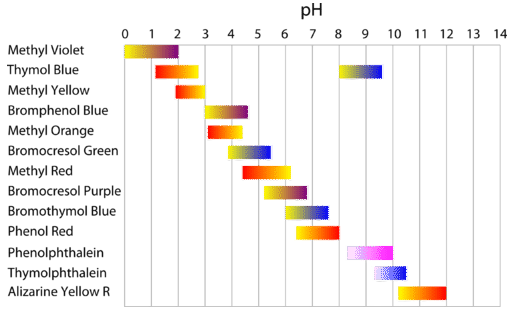
- Properties: Colorless in acidic solutions, turns pink in basic solutions (pH above 8.2).
-
Methyl Orange
- Uses: Used in titrations and to determine the pH of solutions in the acidic range.
- Properties: Red in acidic solutions (pH < 3.1) and yellow in neutral to basic solutions (pH > 4.4).
-
Bromothymol Blue
- Uses: Used in biology labs to detect changes in pH, especially in experiments involving photosynthesis and respiration.
- Properties: Yellow in acidic solutions (pH < 6.0), green in neutral solutions (pH 6.0-7.6), and blue in basic solutions (pH > 7.6).
-
Universal Indicator
- Uses: Provides a full range of colors for different pH levels, allowing for a more precise determination of pH.
- Properties: A mixture of several indicators, shows a gradual change in color over a wide pH range (pH 1-14). Red for strongly acidic, green for neutral, and purple for strongly basic.
-
Phenol Red
- Uses: Used in cell culture and aquariums to monitor pH changes.
- Properties: Yellow in acidic solutions (pH < 6.8), red in neutral solutions (pH 6.8-8.2), and pink in basic solutions (pH > 8.2).
-
Thymol Blue
- Uses: Used in laboratories for pH indication over a wide range.
- Properties: Red in strongly acidic solutions (pH < 1.2), yellow in weakly acidic to neutral solutions (pH 2.8-8.0), and blue in basic solutions (pH > 9.6).
-
Congo Red
- Uses: Used in staining techniques in microbiology and as a pH indicator.
- Properties: Blue in acidic solutions (pH < 3.0), red in neutral to basic solutions (pH 5.0-14).
-
Methyl Red
- Uses: Used in titrations and in microbiological media to detect pH changes.
- Properties: Red in acidic solutions (pH < 4.4), yellow in neutral to basic solutions (pH > 6.2).
-
Bromocresol Green
- Uses: Used in laboratories to monitor pH in various experiments.
- Properties: Yellow in acidic solutions (pH < 3.8), green in neutral solutions (pH 4.0-5.4), and blue in basic solutions (pH > 5.4).
Conclusion:
In chemistry, indicators are essential instruments for figuring out a solution’s pH. It is simple to identify whether a solution is basic, neutral, or acidic by looking at how an indicator’s color changes. Due to their diverse pH ranges and color changes, indicators can be used in a wide range of scientific and industrial contexts.