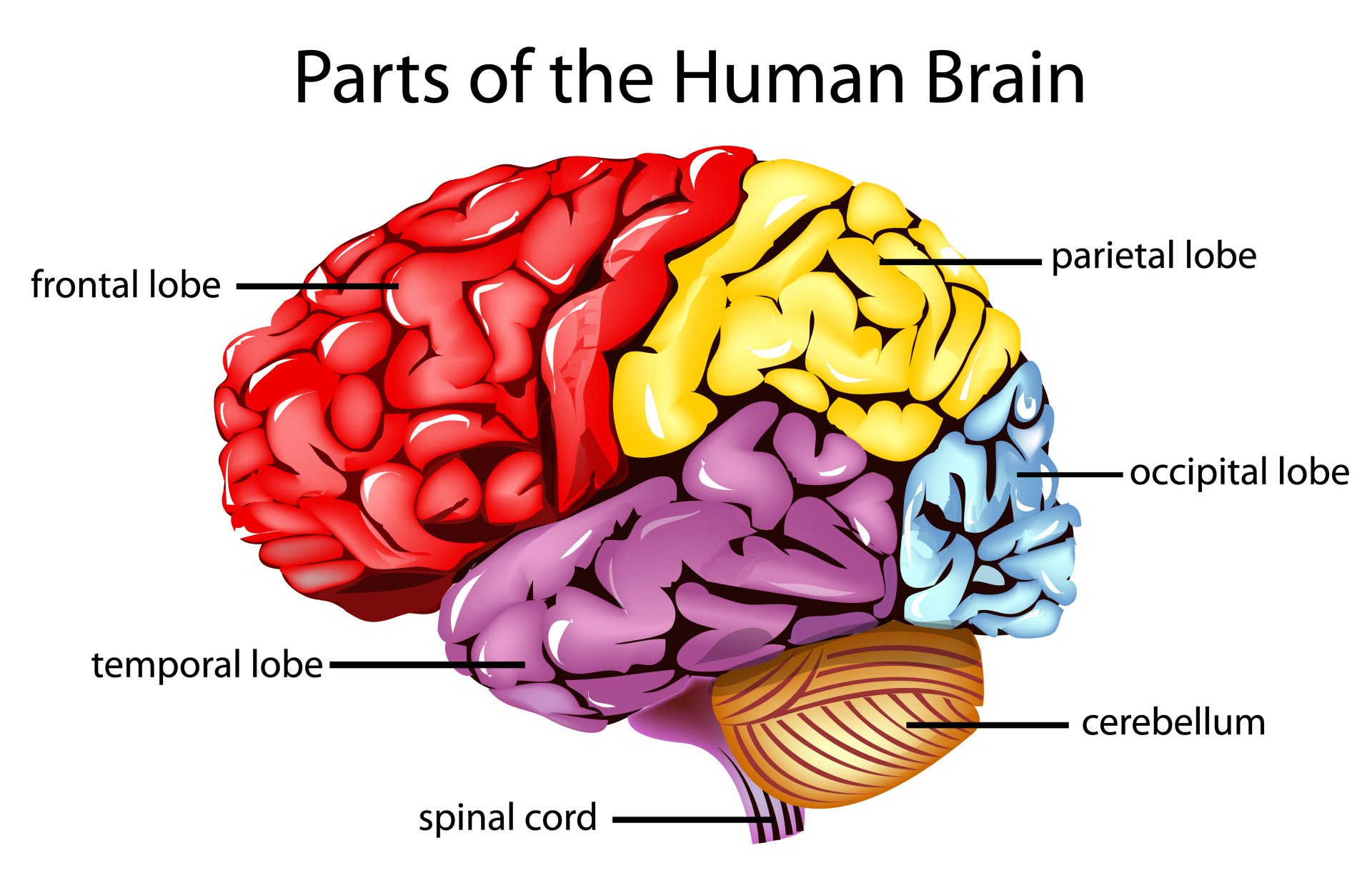
Human Brain
The human brain can be divided into three major parts or regions: the forebrain, midbrain, and hindbrain. These divisions serve as a basic framework for understanding the brain’s anatomy and functions.
1. Forebrain
- The forebrain is the most prominent and complex part of the brain.
- It includes several important structures, such as the cerebral cortex, thalamus, hypothalamus, and limbic system.
Key Components and Functions
- Cerebral Cortex: The outermost layer of the forebrain, responsible for higher cognitive functions, sensory processing, and motor control. It is divided into different lobes, each with specific functions.
- Thalamus: Acts as a relay station for sensory information, directing it to the appropriate regions of the cerebral cortex for processing.
- Hypothalamus: Regulates essential functions such as body temperature, hunger, thirst, and the body’s internal clock (circadian rhythms).
- Limbic System: Involved in emotions, memory formation, and aspects of behavior. Key components include the amygdala and hippocampus.
2. Midbrain
- The midbrain is a smaller region situated between the forebrain and hindbrain.
- It contains the tectum and the tegmentum, which are involved in sensory and motor functions, as well as the substantia nigra, which is crucial for movement.
Key Components and Functions
Tectum: The dorsal part of the midbrain responsible for processing visual and auditory information. It contains the superior and inferior colliculi, which play roles in visual and auditory reflexes.
Tegmentum: The ventral part of the midbrain involved in various motor functions, pain perception, and arousal.
3. Hindbrain
The hindbrain is located at the rear of the brain, adjacent to the spinal cord.
- It includes the cerebellum, pons, and medulla oblongata.
Key Components and Function
Cerebellum: The cerebellum is responsible for coordinating voluntary muscle movements, maintaining balance, and fine-tuning motor skills. It plays a crucial role in motor control and motor memory.
Pons: Serves as a relay station between different parts of the brain and is involved in functions like sl
eep regulation and respiratory control.
Medulla Oblongata: Connects the brain to the spinal cord and controls vital functions such as heart rate, breathing, blood pressure, and reflexe
s like swallowing and vomiting.
These three major parts of the brain, the forebrain, midbrain, and hindbrain, work together to regulate various aspects of human physiology and behavior. While this division provides a simplified overview of the brain’s structure, it’s important to note that the brain functions as an integrated whole, with communication between its regions essential for complex cognitive, sensory, and motor processes.

The brain is divided into several major regions or lobes, each with specific functions:
- Frontal Lobe: Involved in decision-making, problem-solving, motor control, and personality.
- Parietal Lobe: Responsible for processing sensory information, spatial awareness, and some language functions.
- Temporal Lobe: Plays a role in auditory processing, memory, and language comprehension.
- Occipital Lobe: Primarily responsible for visual processing.