
Inheritance refers to how traits, like the color of your eyes or the shape of your nose, are passed from parents to their children. These traits are determined by your genes, which are pieces of the genetic information carried by your DNA. The pattern of inheritance describes how these genes are passed down from one generation to the next. Let’s look at some common patterns of inheritance in easy words:
Dominant Inheritance:
- Imagine that there’s a gene that determines whether you have dimples or not. Let’s call the dimple gene “D.”
- If one of your parents has the “D” gene (they have dimples) and the other parent doesn’t have it (no dimples), you will likely have dimples.
- This is because the “D” gene is dominant, and it overpowers the non-dimple gene.
- So, in dominant inheritance, if you inherit one dominant gene, you’ll express that trait.

Recessive Inheritance:
- Recessive genes are like “hidden” instructions in our DNA.
- To show a recessive trait or disorder, you need to inherit two copies of the recessive gene, one from each parent.
- When you have one dominant and one recessive gene, the dominant gene’s instructions usually win out.
- Now, let’s say there’s another gene called “E” for no dimples. This gene is recessive.
- If both your parents have the “E” gene (no dimples), you will also have no dimples.
- Recessive genes only show their effect when you inherit two of them, one from each parent.
Codominant Inheritance:
- Imagine a gene for blood type. There are three versions: A, B, and O.
- If one parent gives you an “A” gene and the other gives you a “B” gene, you’ll have an AB blood type.
- Both A and B genes are equally powerful, and they express themselves together. This is codominance.

Sex-Linked Inheritance:
-
-
- Sex-linked, as related to genetics, refers to characteristics (or traits) that are influenced by genes carried on the sex chromosomes
-
Males, who have only a single copy of the X chromosome, are more likely to be affected by a sex-linked disorder than females, who have the two copies. In females, the presence of a second, non-mutated copy may cause different, milder, or no symptoms of a sex-linked disorder.
-
For example, color blindness is often carried on the X chromosome.
- If a father has the X-linked trait (color blindness) and passes an X chromosome to his daughter, she could become a carrier of the trait.
- But if he passes it to his son, the son is more likely to express the trait because he only has one X chromosome.
-
Polygenic Inheritance:
- Polygenic inheritance occurs when one characteristic is controlled by two or more genes. Often, the genes are large in quantity but small in effect.
- Many traits, like height or skin color, are influenced by the multiple genes working together.
- Think of it like mixing colors: red, blue, and green can combine to create various shades.
- Several genes contribute a bit to the trait, and their combined effects determine the final outcome.
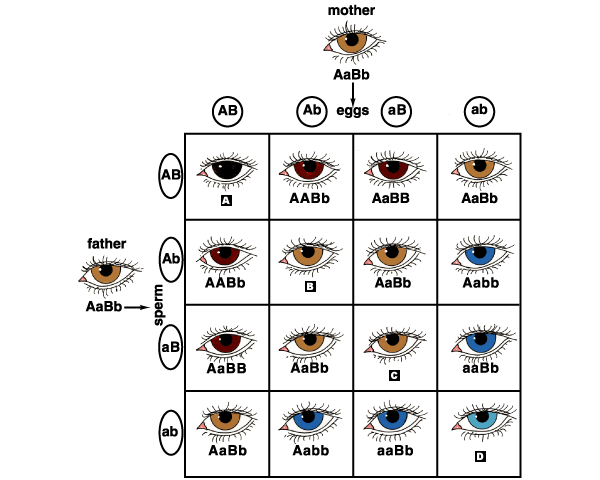
In summary, patterns of inheritance explain how genes are passed down and how they influence our traits. Dominant genes show their effect if you have one, while recessive genes need two copies to be expressed. Codominant genes work together, and sex-linked traits are carried on the sex chromosomes. For complex traits, many genes work together, making it a bit like mixing different ingredients to get the final result.


