
Mitosis
Mitosis is a fundamental process of cell division in eukaryotic cells that results in the production of two identical daughter cells, each having the same number of chromosomes as the parent cell. This type of cell division is responsible for various essential functions in multicellular organisms, including growth, tissue repair, and the replacement of damaged or old cells. Mitosis ensures the continuity of an organism’s genetic information.

Phases of Mitosis
The process of mitosis is typically divided into several distinct phases. These phases are prophase, prometaphase, metaphase, anaphase, and telophase.
Interphase (Preparation Phase)
- Before mitosis begins, the cell goes through an interphase, which includes three subphases: G1 (gap 1), S (synthesis), and G2 (gap 2).
- During G1, the cell is actively growing, carrying out its normal functions, and preparing for DNA replication.
- In the S phase, DNA replication occurs, resulting in the duplication of each chromosome.
- G2 follows DNA replication, during which the cell continues to grow and prepares for mitosis.
1- Prophase
- In prophase, chromatin (the complex of DNA and proteins) condenses into visible, distinct structures called chromosomes.
- Each chromosome consists of two sister chromatids, which are genetically identical and held together at a region called the centromere.
- The nuclear envelope begins to break down, and the mitotic spindle, a structure made of microtubules, starts to form.
- The spindle fibers extend from the centrosomes, which are organizing centers for microtubules located at opposite poles of the cell.
2- Metaphase
- During metaphase, the chromosomes align along the cell’s equator, known as the metaphase plate.
- The spindle fibers attach to the centromeres of the chromosomes, ensuring that each sister chromatid will be pulled to opposite poles of the cell during the next phase.
3- Anaphase
- Anaphase is characterized by the separation of sister chromatids. The centromere holding each chromatid pair together splits, and the spindle fibers pull the sister chromatids toward opposite ends of the cell.
- This results in the distribution of one complete set of chromosomes to each of the two emerging daughter cells.
4- Telophase
- In telophase, the separated chromatids reach opposite poles and begin to decondense, returning to their less compacted chromatin form.
- A new nuclear envelope forms around each set of chromosomes, creating two distinct nuclei.
Cytokinesis
- Cytokinesis is the final step of cell division and occurs after mitosis.
- During cytokinesis, the cell membrane pinches in, or a cell wall forms, dividing the cell into two daughter cells, each with its nucleus and set of organelles.
- In animal cells, this process is often accomplished through the formation of a cleavage furrow, while in plant cells, a cell plate forms.
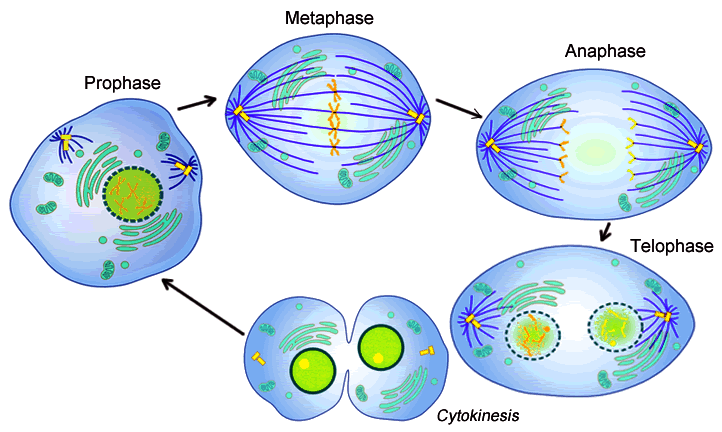
The result of mitosis is the production of two genetically identical diploid (2n) daughter cells from one diploid parent cell. These daughter cells are crucial for the growth and maintenance of the organism, as they have the same genetic information and functions as the parent cell.


