
DNA Replication
DNA replication is the process by which a cell makes an exact copy of its DNA. This process is crucial for cell division, growth, and the passing of genetic information from one generation of cells or organisms to the next. DNA replication follows a precise and highly regulated sequence of steps, ensuring that the genetic information is faithfully transmitted.
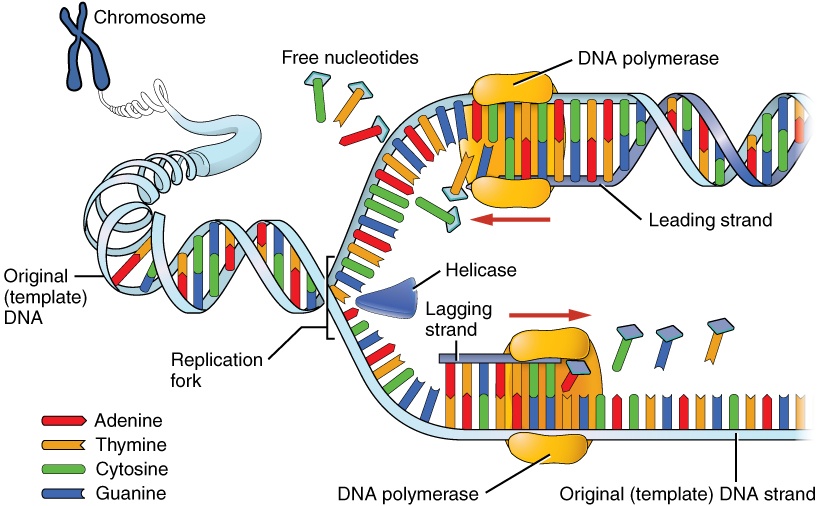
Here’s a simplified overview of how DNA is copied and made:
Separation of DNA Strands
- The process begins by unwinding the DNA double helix, which consists of two complementary strands coiled around each other.
- An enzyme called DNA helicase unwinds and separates the two strands by breaking the hydrogen bonds between the base pairs (adenine with thymine, and cytosine with guanine).
Formation of the Replication Fork
- As the DNA strands separate, they create a Y-shaped structure called the replication fork.
- At the replication fork, the DNA molecule is now exposed and ready to be copied.
DNA Polymerization
- DNA polymerases are enzymes responsible for synthesizing new DNA strands.
- These enzymes start at a specific point on the DNA strand, called the origin of replication.
- DNA polymerases add new nucleotides to the growing DNA strand by matching them with the complementary bases on the template strand. (A pairs with T, and C pairs with G)
- The nucleotides are assembled in a 5′ to 3′ direction, which means the new strand is elongated from its 3′ end.
Leading and Lagging Strands
- Because DNA is double-stranded, replication occurs differently on each strand.
- The leading strand is synthesized continuously in the 5′ to 3′ direction as the replication fork opens.
- The lagging strand is synthesized in short fragments called Okazaki fragments in the 5′ to 3′ direction, away from the replication fork. These fragments are later joined together.
Primer Synthesis
- Before DNA polymerases can add new nucleotides, a short RNA primer is synthesized by another enzyme called primase.
- The RNA primer provides a starting point for DNA polymerases to add nucleotides.
Proofreading and Repair
- DNA polymerases have a proofreading function, which allows them to detect and correct errors in nucleotide base pairing as they add new bases.
- Other repair mechanisms also exist to fix any mistakes that may occur during replication.
Termination
- Replication continues until the entire DNA molecule is copied.
- Eventually, the replication process reaches the end of the DNA molecule, and the newly synthesized strands are complete.
Two Identical DNA Molecules
- At the end of DNA replication, two identical DNA molecules are produced, each consisting of one original (parental) strand and one newly synthesized (daughter) strand.
This process ensures that genetic information is faithfully duplicated during cell division, ensuring that each daughter cell receives a complete and accurate set of genetic instructions.
